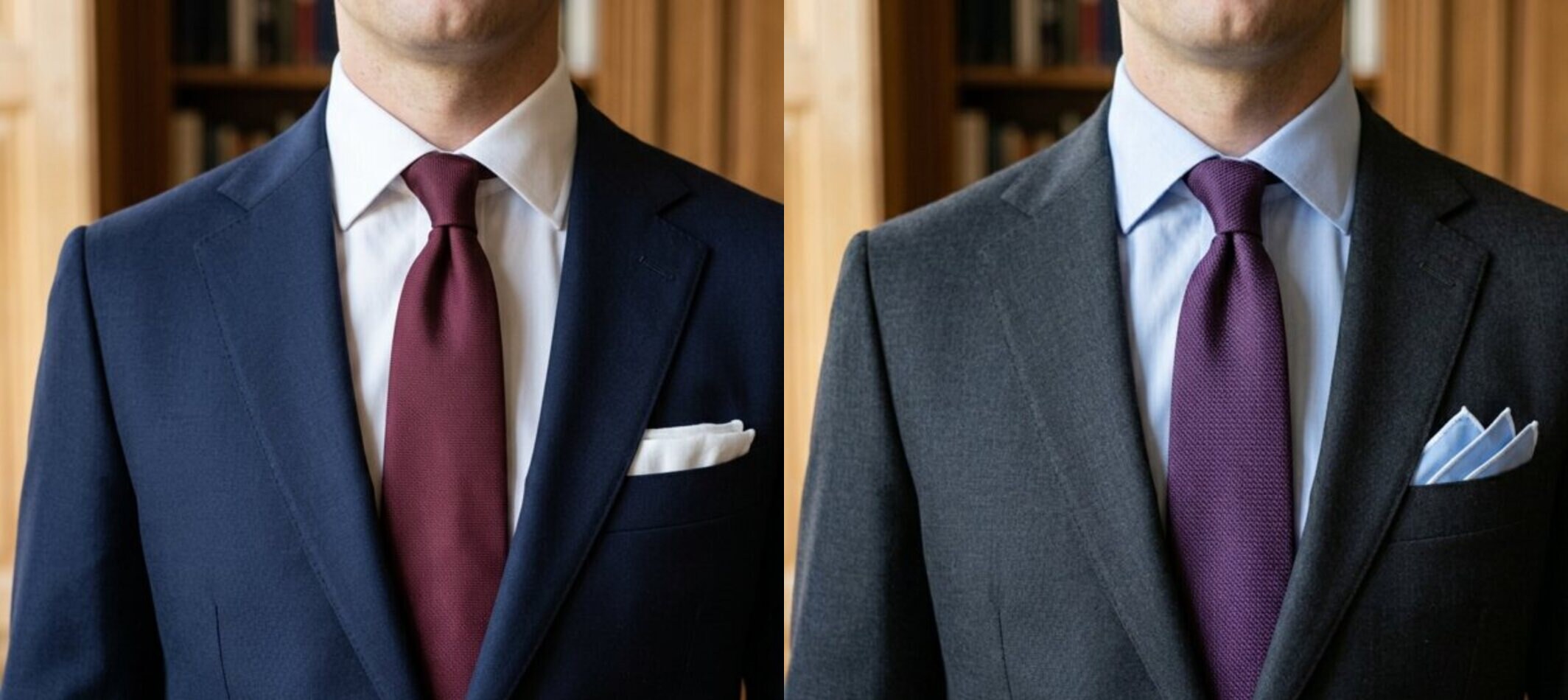
Tie Length: How Long Should a Tie Be?
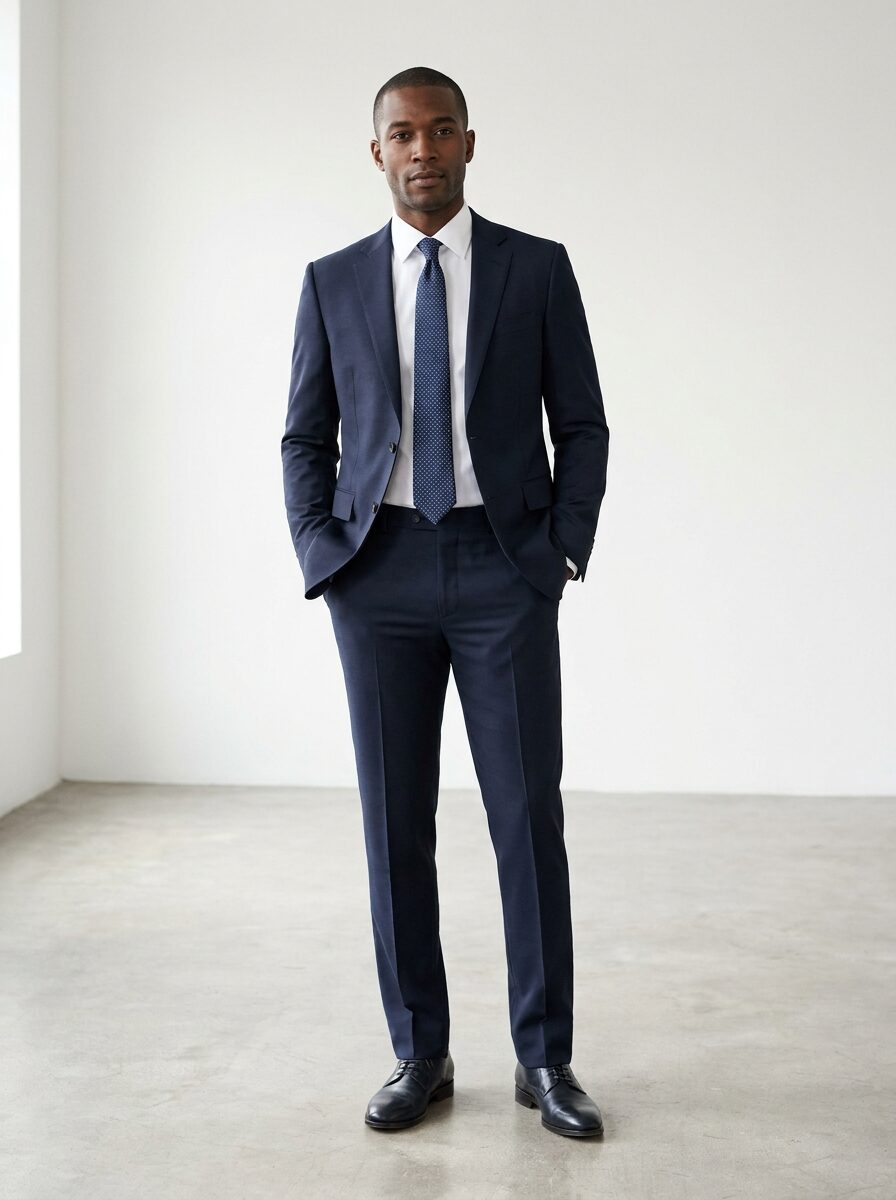
A tie is the correct length when the tip of the wide blade reaches the middle of your belt buckle, not above the waistband and not below it. A standard tie is 57 to 58 inches and suits most men up to about 6'2". Taller men, or men with a larger neck, usually need an extra-long tie of 61 to 62 inches.
The tip of your tie should reach your belt buckle. Once it is tied, the wide blade should end somewhere between the top and the middle of the buckle, never above the waistband and never hanging below it.
That one line fixes more outfits than any tie colour ever will. A tie that stops at your stomach makes a good suit look like it belongs to someone else, and a tie that hangs past your belt looks sloppy.
Here is how to get the length right for your height, and what changes it.
Why tie length throws off the whole outfit
A tie draws a line down the centre of your body. Where that line stops is where the eye stops.
Too short, and it cuts your torso off high, which makes you look wider through the middle. Too long, and the tip points past the belt toward the zip, which nobody wants attention on. Right at the buckle, the tie finishes the line cleanly where your jacket and trousers meet.
It shows most with the jacket open. Buttoned, a jacket hides a lot. Open, at a wedding or a dinner, the whole tie is on show.
Tie length by height
Most ties are sold at one length, but men are not one height. This is the guide I use.
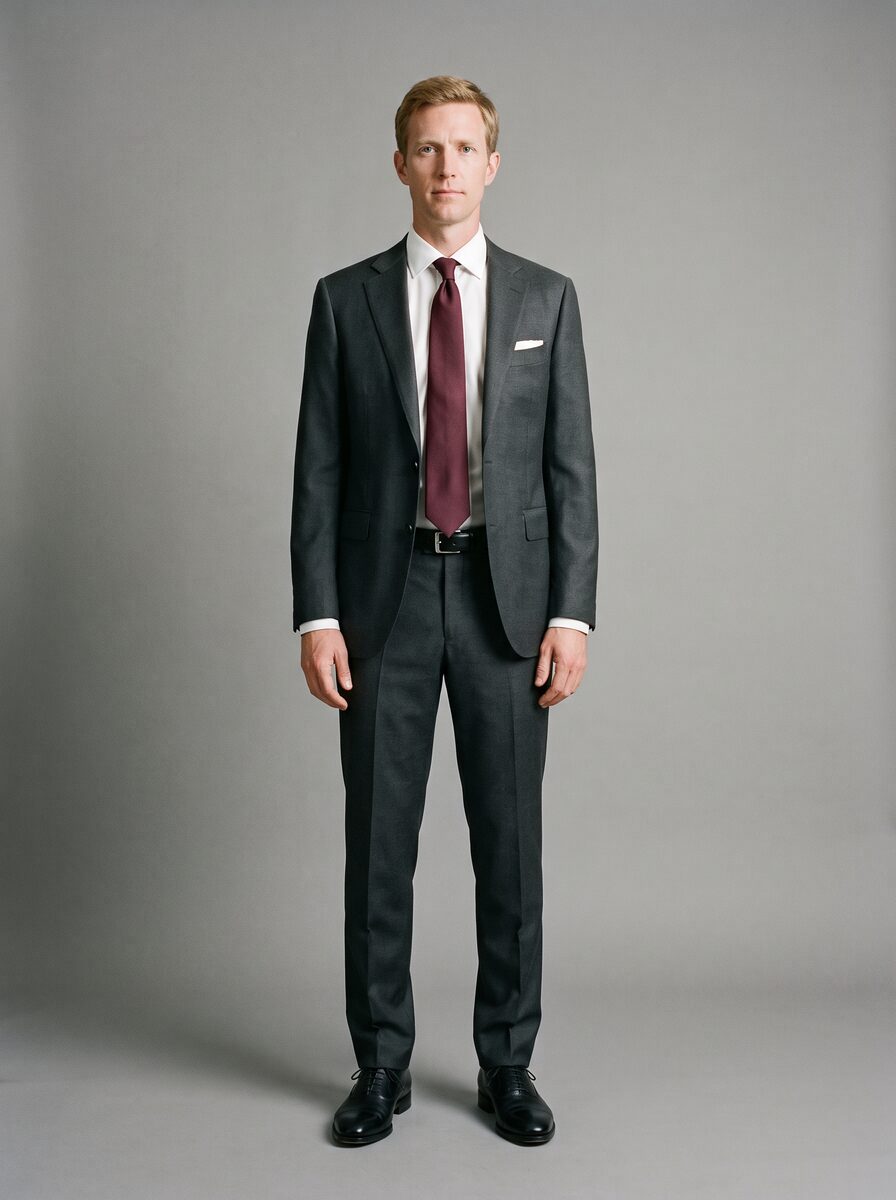
*A note on the cloth: the fabrics and linings in these photographs are examples, not a fixed menu. Every lining is chosen for the man it is made for, so yours will be its own. Our books also change as mills come and go, and they change without notice. If a cloth you have chosen is unavailable when your order is placed, we replace it with one of the same quality or better, as close to the colour as we can get, and we tell you before anything is cut.*
- Under 5'8": a standard tie usually still works, tied with a larger knot to take up the extra. Some shorter men prefer a 54 to 56 inch tie. Most men should skip the full Windsor, and shorter men especially: it is a wide knot that eats length. A smaller knot, or a shorter tie, solves it. We make our ties to the length you need.
- 5'8" to 6'2": a standard 57 to 58 inch tie.
- 6'2" to 6'5": an extra-long tie, 61 to 62 inches.
- Over 6'5": 62 inches or more, and often the knot choice has to help too.
Height is only part of it. Your neck size and the length of your torso count just as much. A 6'0" man with a 17.5 inch neck can run out of tie the same way a 6'4" man with a slim neck does, because more of the tie goes around his collar. A long torso eats length too.
The simple test: tie it with your usual knot, stand up straight, and look where the tip lands. If you need to tie it three times to hit the buckle, the tie is the wrong length for you.
If proportion is a wider problem for you, our guides to suits for tall men and suits for shorter men cover the jacket and trousers too.
58 vs 62 inch tie: which do you need?
A 58 inch tie is the standard. A 62 inch tie is the extra-long size, sometimes sold as XL.
Pick 58 inches if you are under about 6'2" with an average neck. Pick 62 inches if you are taller than that, if your neck is 17.5 inches or larger, or if you like a full Windsor knot. If you are right on the line, try a 58 with a four-in-hand knot first. It uses the least tie. If the tip still sits above your waistband, you need the 62.
Four inches sounds small. Once the tie is knotted, it is the difference between a tip at your navel and a tip at your buckle.
Are ties different lengths?
Yes. Most ties sold are 57 to 58 inches, which is why so many men assume ties are one size. Extra-long ties at 61 to 62 inches are made for taller and bigger men, and shorter ties around 54 inches exist too, though they are harder to find.
Width varies as well, and that is the next thing to get right.
Tie width and lapel width
Length gets the tie to the right place. Width is about balance with the jacket.
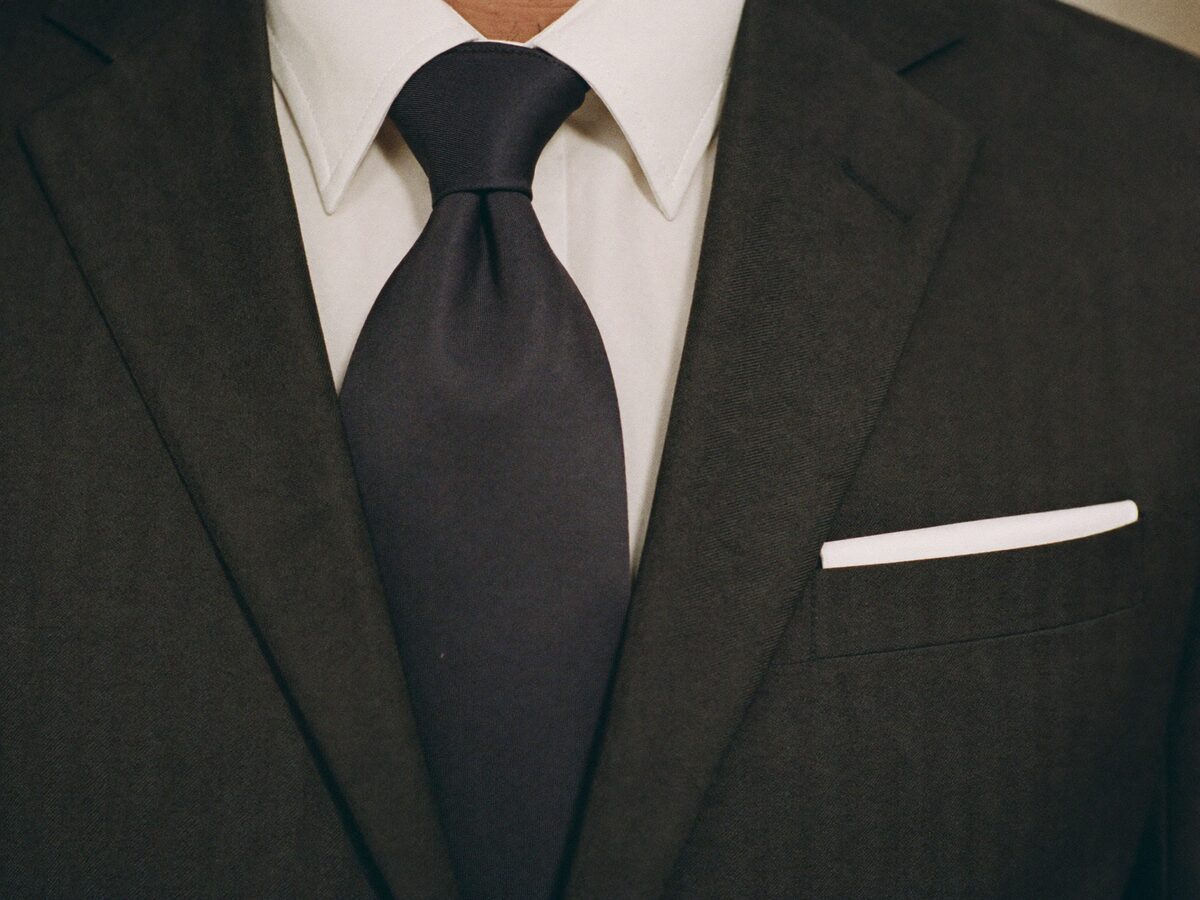
Match the widest part of the tie roughly to the width of your lapel. A standard lapel is around three to three and a half inches, and so is a standard tie. A slim lapel wants a slimmer tie, around two and a half inches. A wide peak lapel on a larger man looks better with a slightly wider tie.
Your build is part of it. A broad-chested man in a skinny tie looks bigger than he is. A slim man in a wide tie looks swamped. Our post on suit lapel styles shows the lapel side of the equation.
How the knot changes the length
The knot uses tie. Different knots use different amounts, and that changes where the tip lands.

The four-in-hand is the smallest and slightly uneven knot, and it uses the least length. It is the right knot for tall men on a standard tie and for most everyday wear.
The half Windsor is a little fuller and symmetrical. It uses more length than a four-in-hand, and it suits most shirt collars.
The full Windsor is the biggest knot and uses the most length, often a few inches more than a four-in-hand. It needs a spread collar to sit properly, and on a tall man it can leave a standard tie too short.
If your tie keeps landing too long, go up a knot. If it keeps landing short, go down one, or move to an extra-long tie.
Common tie length mistakes
These are the ones I see most:
- The tip stops above the waistband, usually because the tie is too short for a tall man or the knot is too big.
- The tip hangs below the belt, often on shorter men wearing a standard tie with a small knot.
- The thin back blade hangs longer than the front. Tuck it through the loop on the back of the tie. If there is no loop, the knot needs to start further along.
- The tie is tucked into the trousers to hide the length. It looks like a mistake because it is one.
- The trousers sit low on the hip. Suit trousers should sit at your natural waist, and a tie that hits the buckle on low-rise trousers will look long. Our trouser fit guide covers the rise.
Getting the rest right
A tie at the right length on a suit that does not fit still looks off. The two work together.
For tie colour, our guide on how to match a tie to your suit covers the rules, and there is a whole post on tie colours for a navy suit. If you are going without one, here is how to wear a suit without a tie.
Our ties are $95, and suits start at $899. If you would like someone to plan which ties, shirts, and suits go together for your build and your work, the Wardrobe Plan does that: a session with our Owner and Founder, Derek Burbidge. Book your Wardrobe Plan. Our suit price calculator prices your outfit in about ten seconds.
Frequently Asked Questions
Where should the tip of a tie land?
At your belt buckle, between the top and the middle of it. Not above the waistband and not below the belt.
What is the correct tie length for men?
A standard tie is 57 to 58 inches, which suits most men up to about 6'2". Taller men, or men with a neck of 17.5 inches or more, usually need a 61 to 62 inch extra-long tie.
What is the average tie length?
About 57 to 58 inches for a standard adult tie. We make ours to the length you need, so a very tall or a shorter man is not stuck with the standard.
Should I buy a 58 or 62 inch tie?
Buy 58 inches if you are under about 6'2" with an average neck. Buy 62 inches if you are taller, have a larger neck, or like a full Windsor knot.
Can a tie be too long?
Yes. If the tip hangs below your belt, it is too long. Try a larger knot, such as a half or full Windsor, which uses more tie.
Can a tie be too short?
Yes, and it is the more common problem for tall men. If the tip sits above your waistband, use a smaller knot like the four-in-hand or move to an extra-long tie.
Does the knot change tie length?
Yes. A four-in-hand uses the least tie, a half Windsor more, and a full Windsor the most. The same tie can land at your buckle with one knot and above your waistband with another.
How wide should a tie be?
Roughly the width of your lapel. For most suits that is three to three and a half inches. Slim lapels take a slimmer tie.
Tie length is one small fix. Most closets have a few more. Take the two-minute style quiz and see what your colouring suits and what to add first.
Take the Style Quiz